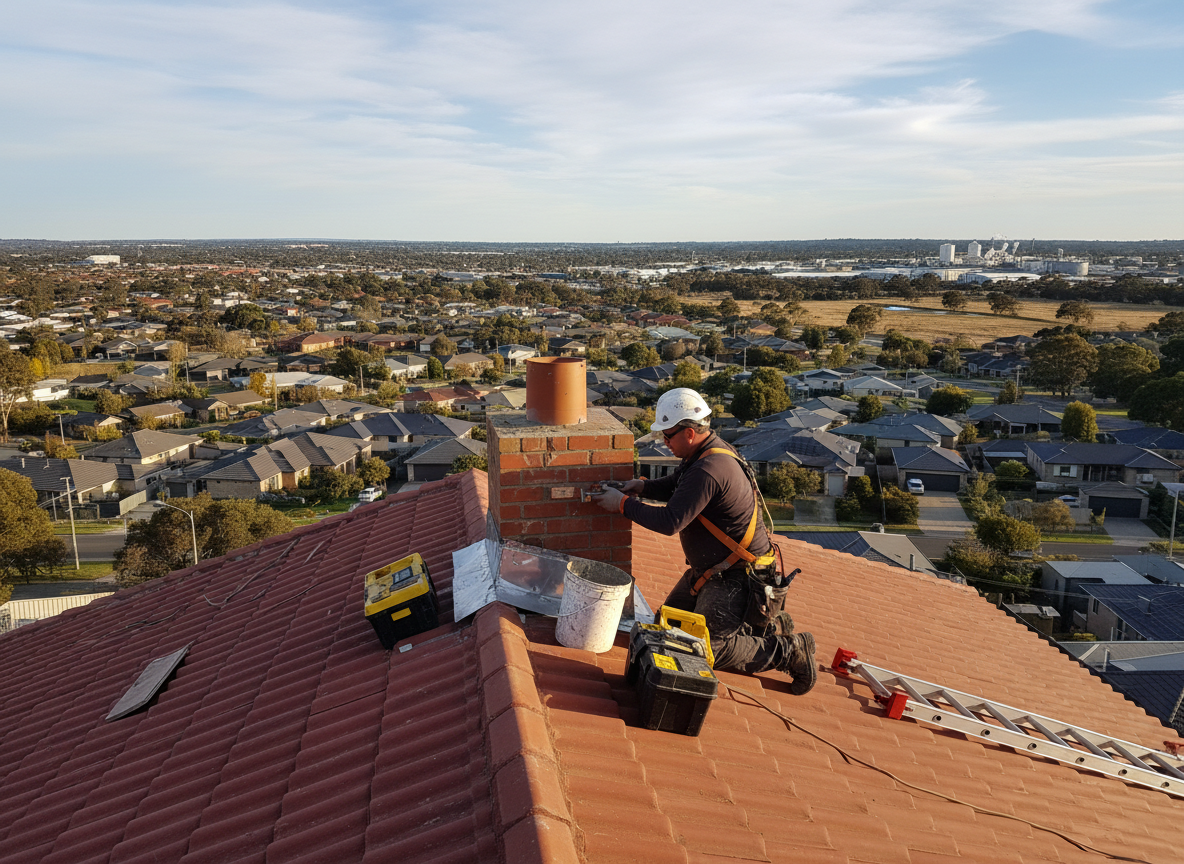
Chimney leaks in Werribee often trace to cracked flue liners or failed flashing where older brick stacks meet tiled roofs. Homes in Riverbend and near Werribee Park commonly date from the 1970s and 1980s, when mortar joints were laid without modern expansion allowances. Warm summers expand the brick while winter rains then drive water through the gaps, soaking ceilings in living rooms below. Technicians must check both the exterior crown and the internal smoke chamber because water can travel several courses down before appearing indoors.
In newer estates around Tarneit and Wyndham Vale the chimneys are often metal inserts set into lightweight timber frames. These setups leak at the roof penetration when the silicone sealant dries out after repeated hot summers. Access is tighter than in solid masonry stacks, so repairs require removing roof tiles rather than working from a ladder alone. Hoppers Crossing properties built on clay soils also see minor settlement that tilts the chimney slightly, opening the flashing line on the downhill side.
Repairs here always start with a camera inspection from the firebox up through the flue. Any vegetation or debris from nearby Werribee Open Range Zoo parkland is cleared first because it traps moisture against the crown. Only breathable lime-based pointing is used on heritage-style brickwork to avoid trapping salts that would spall the faces in the next warm season. Homeowners in the City of Wyndham are advised to schedule checks before the first autumn rains rather than waiting for visible drips.
Technician insight
In Werribee the thing that catches most people out with chimney leak repair is how the warm summers dry out the mortar then the first winter rain finds every hairline crack in the older stacks around Werribee Park and Riverbend. Homeowners often seal only the visible roof flashing and miss the crown itself, so water keeps entering the flue and running down inside the walls.
Tarneit Metal Insert Leak
Water stains appeared on a Tarneit ceiling after a warm spell. Inspection showed dried sealant at the roof penetration and minor frame settlement. The insert was resealed with high-temperature flashing and the crown rebuilt to restore drainage.
How it works
- 1
Initial Inspection
Camera survey of flue and crown from 114B Watton St base, checking Tarneit and Wyndham Vale properties for water tracking paths.
- 2
Source Identification
Pinpoint failed flashing, cracked crown or liner gaps common in Riverbend brick stacks after warm summers.
- 3
Repair Execution
Replace or reseal flashing, repoint with lime mortar, and install new crown where settlement from local clay soils has shifted the stack.
- 4
Final Test
Water test from roof level and visual confirmation no moisture reaches the smoke chamber before leaving site.
Pricing
Upfront quotes provided after on-site inspection.