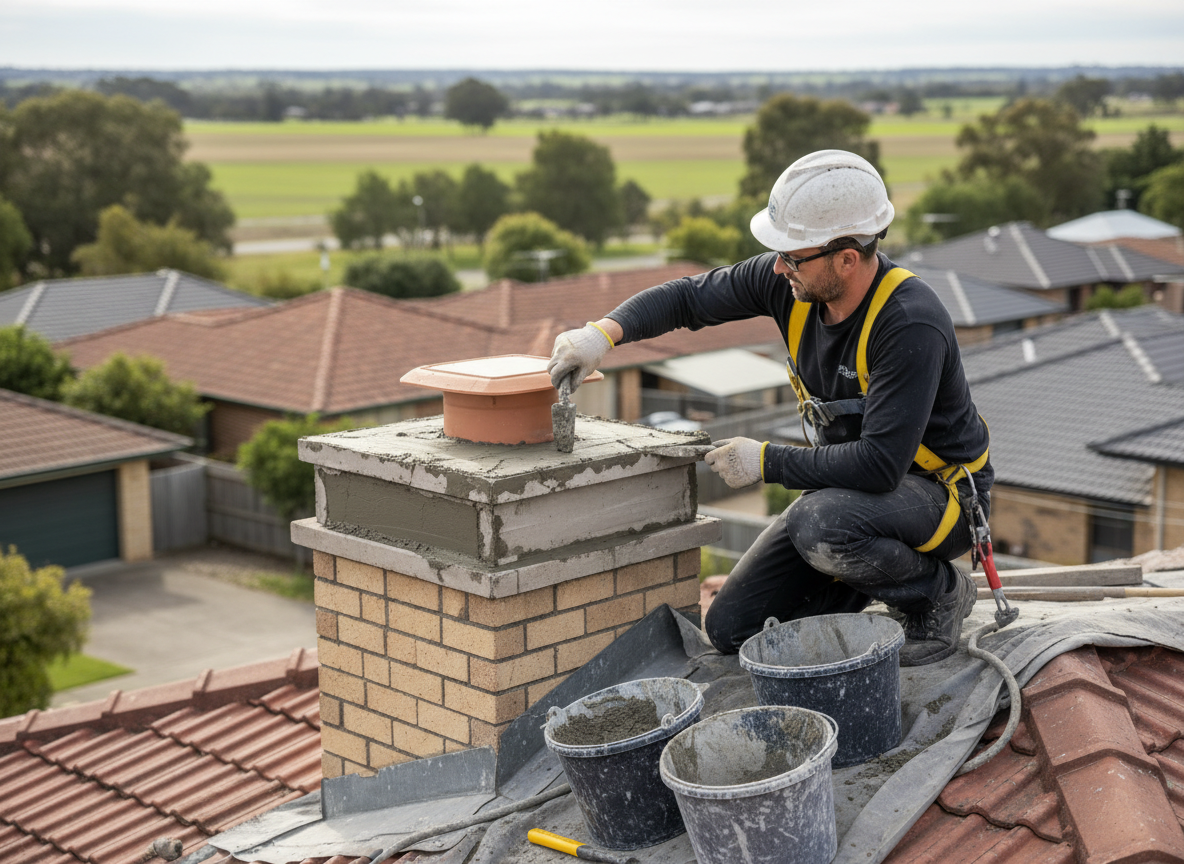
Chimney crowns in Werribee homes built before the 1990s often show spalling and hairline cracks within fifteen years because the original concrete mix lacked modern air entrainment suited to the City of Wyndham's freeze-thaw cycles. We use a 4000 psi fibre-reinforced mix with integral water repellent when rebuilding crowns on properties near Werribee Park or the older pockets of Riverbend. The slope must be maintained at least one inch per foot so summer downpours drain before they reach the flue tile joints.
Access on single-storey weatherboard houses in Tarneit and Wyndham Vale is usually straightforward from the roof, but two-storey brick homes closer to Hoppers Crossing frequently require scaffolding because the crown sits above the second-floor line. We always check the flashing where the crown meets the roof deck; in many 1970s and 1980s Werribee South properties the original lead step flashing has corroded and must be replaced at the same time to prevent water tracking behind the brickwork.
Local soil movement in the Werribee plains area creates subtle chimney settlement that shows up first as crown separation on the south-west corner. We install a 10 mm expansion joint filled with high-temperature silicone before the new crown cures, allowing the stack to move independently without re-cracking the concrete. This detail is especially important on homes within five kilometres of the Werribee Open Range Zoo where wind exposure is higher.
Technician insight
In Werribee the thing that catches most people out with chimney crown repair is the clay soil movement in the western parts of Wyndham Vale and Tarneit. Homeowners assume the crown just needs a patch, but once the stack shifts even 5 mm the new concrete cracks again within two winters unless we install a proper expansion joint first.
Riverbend Brick Chimney Settlement
The crown on a 1980s brick home in Riverbend had separated along the south edge after recent heavy rain. We found the original concrete had no expansion allowance and the flashing was lifting. We removed the damaged section, installed an expansion joint and repoured the crown with correct pitch, then replaced the corroded step flashing. Water now sheds cleanly and no new cracks have appeared after the first summer.
How it works
- 1
Site Inspection
We assess the crown condition, flue alignment and flashing integrity from the roof on properties across Tarneit, Riverbend and Wyndham Vale.
- 2
Material Removal
Loose concrete and damaged sections are cut out to sound substrate while protecting the flue tiles and roof membrane.
- 3
Form and Pour
New reinforced concrete is placed with correct pitch and an expansion joint to accommodate local soil movement.
- 4
Curing and Flashing
The crown cures for seven days before we reinstall or upgrade step flashing to ensure a watertight seal.
- 5
Final Check
We test drainage with water and confirm no new cracks have formed before leaving the site.
Pricing
Cost depends on roof height, extent of damage and whether scaffolding is required; we provide upfront quotes after inspection.